



The signing of the India-European Union Free Trade Agreement (FTA) marks a significant turning point for global trade and the automotive industry. After years of negotiations, the agreement opens the door to deeper economic cooperation between two of the world’s largest markets. Among the first global automakers to express strong support for the deal is Renault, the French automotive major with a long-standing presence in India.
Renault’s positive response to the India-EU FTA highlights how the agreement could reshape investment flows, manufacturing strategies, and cross-border collaboration between Europe and India. For the automotive sector, in particular, the deal signals new growth opportunities while reinforcing India’s importance as a global manufacturing and innovation hub.
Why the India-EU FTA Is a Landmark Agreement
The India-EU FTA is widely seen as one of the most comprehensive trade agreements India has entered into. It aims to reduce tariffs, simplify trade regulations, and encourage investment across multiple industries, including automobiles, components, technology, and services.
For years, high import duties have made it challenging for European automakers to bring vehicles into India. Under the new agreement, these duties will be reduced gradually over a defined period, with safeguards and quotas to protect domestic manufacturers. This balanced approach allows India to remain competitive while opening selective pathways for global brands.
At the same time, Indian manufacturers and suppliers gain improved access to European markets, creating a more two-way trade ecosystem rather than a one-sided import model.
Renault’s Perspective: Confidence in Long-Term Growth
Renault has openly welcomed the India-EU FTA, describing it as a strong signal of deeper cooperation between Europe and India. According to company leadership, the agreement strengthens confidence in long-term investment decisions and supports Renault’s strategy of building strong regional ecosystems.
Renault operates across both Europe and India, giving it a unique advantage under the FTA. The company views the agreement not merely as a tariff-reduction mechanism but as a platform for broader collaboration in manufacturing, technology, and innovation.
By improving trade predictability and reducing friction, the FTA allows Renault to plan future investments with greater clarity and confidence.
India’s Growing Role in Renault’s Global Strategy
India continues to play a crucial role in Renault’s global plans. Beyond being a large consumer market, the country is increasingly seen as a strategic manufacturing and export base. Competitive costs, a skilled workforce, and improving infrastructure make India an attractive destination for long-term automotive investments.
The FTA further enhances this position by enabling smoother movement of components and vehicles between India and Europe. Renault has indicated that India could play a bigger role in its global supply chain, especially for compact cars, SUVs, and automotive components.
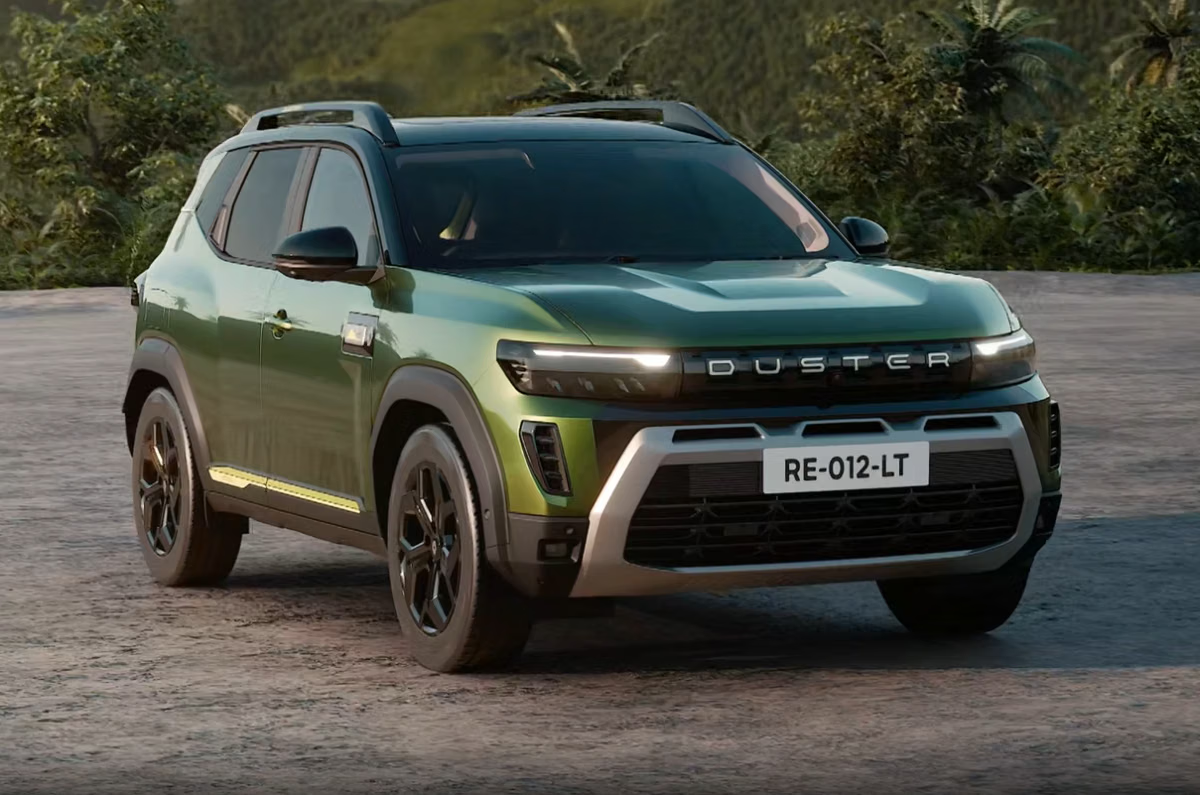
Recent product showcases and future model plans underline Renault’s renewed focus on the Indian market, signaling confidence in sustained demand and policy stability.
Impact on Automotive Manufacturing and Supply Chains
One of the most significant outcomes of the India-EU FTA is its potential to reshape automotive supply chains. Reduced trade barriers make it easier for manufacturers to source components across borders, optimize costs, and improve efficiency.
For Renault, this means:
- Greater flexibility in sourcing parts from India for European operations
- Opportunities to increase local sourcing within India
- Stronger integration between European design and Indian manufacturing
Indian auto component manufacturers are also expected to benefit, as improved market access to Europe could drive exports, technology upgrades, and job creation.
Balancing Market Access and Domestic Protection
While the FTA brings new opportunities, it has been designed with caution. Most segments of India’s automotive market will remain protected, especially in mass-market and entry-level categories. Tariff reductions are phased and limited, ensuring domestic manufacturers are not exposed to sudden competition shocks.
This balanced framework reassures both global investors and local players. For companies like Renault, it creates a stable environment where global collaboration can coexist with local manufacturing priorities.
What the FTA Means for Consumers
From a consumer perspective, the immediate impact may be gradual rather than dramatic. Prices of imported European vehicles are unlikely to drop overnight, as tariff reductions are phased and quota-based.
However, over time, consumers may benefit from:
- Wider model choices
- Advanced technologies and powertrains
- Improved quality standards
- Stronger competition in premium segments
For Renault customers in India, this could translate into more globally aligned products and faster adoption of international innovations.
Challenges and Considerations Ahead
Despite its promise, the India-EU FTA is not without challenges. Regulatory alignment, infrastructure readiness, and policy implementation will play critical roles in determining its success.
Automakers must also adapt to evolving environmental norms, electrification goals, and digital transformation requirements. Renault’s experience across diverse markets positions it well to navigate these complexities, but execution will be key.
Additionally, the agreement still requires formal ratification and phased rollout, meaning its full impact will unfold over several years rather than immediately.
A Strong Signal for Future Collaboration
Renault’s endorsement of the India-EU FTA reflects growing confidence in India as a global automotive powerhouse. The agreement strengthens economic ties, encourages sustainable investment, and promotes collaboration beyond traditional trade boundaries.
For the automotive industry, the FTA represents a shift toward integrated global ecosystems where innovation, manufacturing, and market access work together. Renault’s response suggests that global automakers are ready to align their long-term strategies with this vision.
Conclusion
The India-EU Free Trade Agreement marks a pivotal moment for the automotive industry, and Renault’s welcoming stance underscores its strategic importance. By encouraging investment, enhancing collaboration, and strengthening supply chains, the agreement sets the stage for sustained growth across both regions.
As the FTA moves toward implementation, companies like Renault are likely to play a leading role in shaping the next phase of Europe-India automotive cooperation. While challenges remain, the direction is clear: a more connected, collaborative, and globally competitive auto industry lies ahead.